Recently a close friend saw the unread count badge on my Messages app and was shocked. “Do you really have over 200 unread messages?” he asked.
We were collaborating on a project and as I mindlessly ⌘-tabbed through apps to show him something, the incriminating red bubble flew across my path as if it didn’t exist. The sudden, visceral reaction caught me off guard in more ways than one.
Merlin Mann’s iPhone, inbox zero and filing chapter 11
Milliseconds after the words left my friend's mouth, my mental search engine automatically retrieved a screenshot of Merlin Mann's iPhone circa 2011 (15 years ago)1. The iPhone was only a few years old and techy productivity enthusiasts like me were obsessing over how to organize all of their apps.
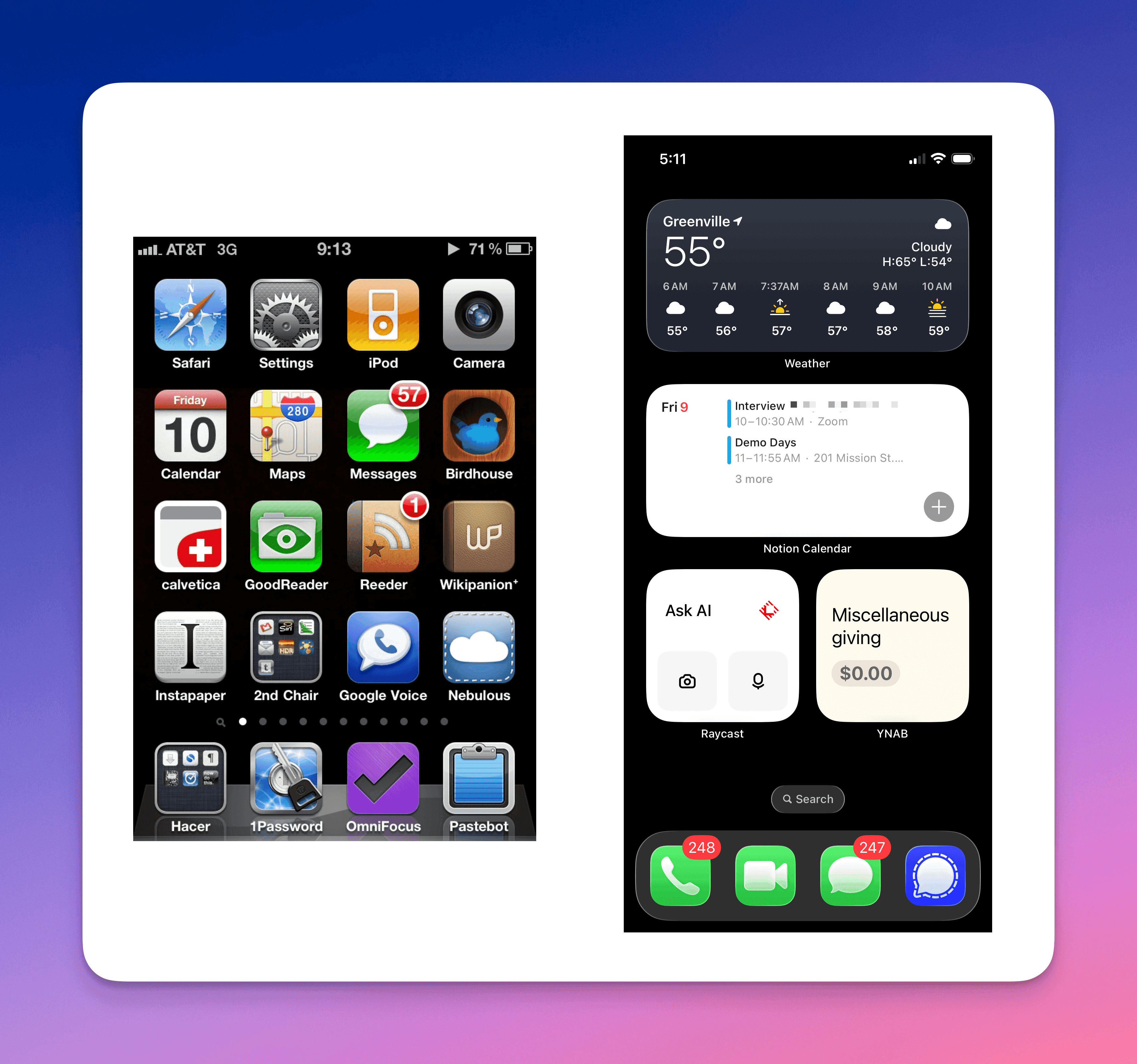
The first time I saw the screenshot, I had the same reaction as my friend: how does Merlin have 57 unread iMessages?
Merlin coined the term “inbox zero,” and I’ve applied his methodology rigorously with email and Slack for almost two decades. Sharing a high unread count with one of my productivity heroes was comforting, but it also made me think hard about why I haven’t extended inbox zero to text messaging.
I told my friend I was filing for chapter 11 text message bankruptcy, and this post is where I’m going to begin the process of reorganizing, starting with unpacking my thoughts on how I (we) got here.
Communication channels have become streams of entertainment
Email was my first experience with digital communication. I remember my parents reading emails from family members to me and my siblings out loud. We used a single AOL email account for the entire family. I distinctly remember thinking about email as a dramatically more efficient form of sending letters.
Lionel Dricot, known as Ploum online, recently wrote an article titled How we lost communication to entertainment2. He argues:
All our communication channels are morphed into content distribution networks. We are more and more entertained but less and less connected.
Regarding email specifically, he writes:
But for most people, their email inbox is simply one more feed full of bad advertising. They have 4 or 5 digit unread count. They scroll through their inbox like they do through their social media feeds.
If the medium is the message3, dopamine is the headline for modern communication channels. The days of longer-form, digital letter writing are gone for most people, including me.
Analyzing 20 years of sent emails
I wanted to understand this trend with data, so I analyzed almost 20 years of sent emails across two personal email accounts.
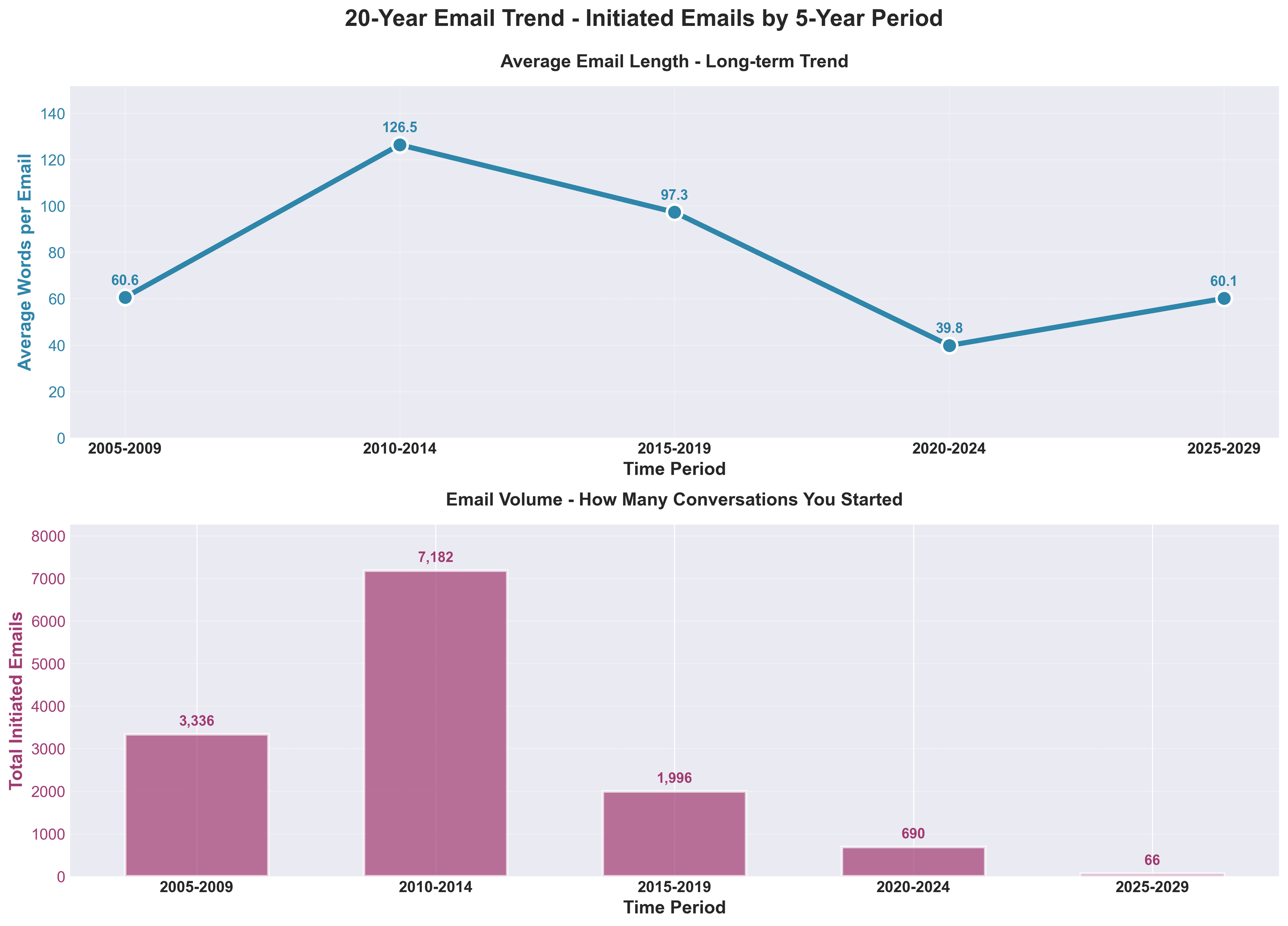
This first chart shows email length and number of emails sent. It confirms that:
- I sent far more emails in the first decade
- The average length of emails I've sent has decreased
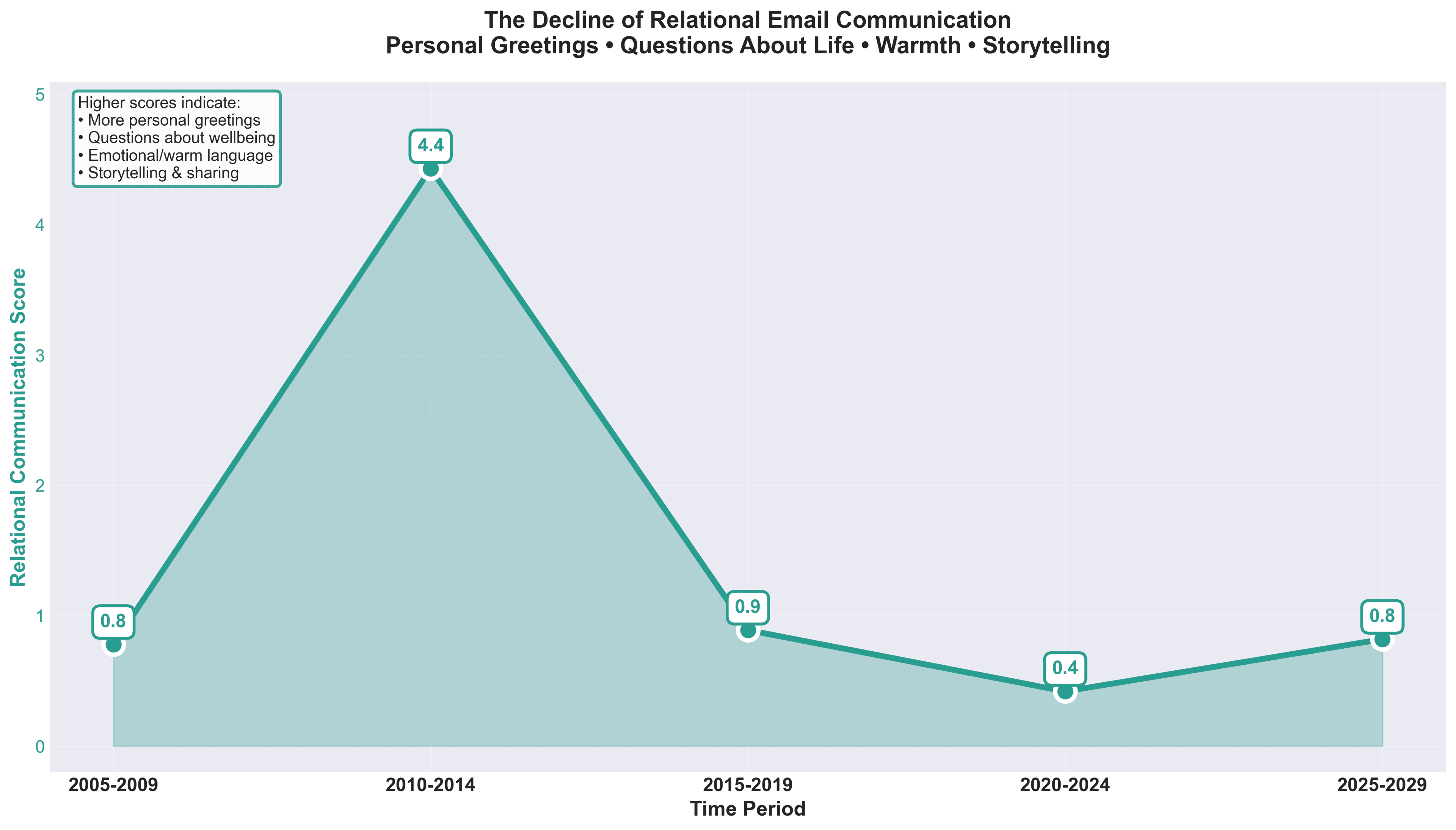
The second chart indexes emails for relational content (versus transactional). As expected, the trend line holds:
This same trend is happening with text messages. Many group messages, even among close friends, tend towards entertainment, especially with features like rich snippets and native GIF search.
Like any medium, text messages can be proactively managed. It's a tool wielded by the user. At the same time, the medium has changed and unread messages are standard fare for entertainment. These are Nicholas Carr's shallows4, played out in communication.
Text messaging feels weightless and rewards synchronous exchanges
In 2007, Merlin Mann wrote about "the pebble problem" in email5:
Email is such a funny thing. People hand you these single little messages that are no heavier than a river pebble. But it doesn't take long until you have acquired a pile of pebbles that's taller than you and heavier than you could ever hope to move, even if you wanted to do it over a few dozen trips. But for the person who took the time to hand you their pebble, it seems outrageous that you can't handle that one tiny thing. "What 'pile'? It's just a f*cking pebble!"
If emails are river pebbles, text messages are grains of sand, especially with the advent of features like tapbacks6.
Text messaging is theoretically asynchronous, but Apple's design of the Messages app rewards immediacy. Aside from notifications being on by default, features like the typing indicator (when someone is responding) increase our expectations of getting a response quickly, which exacerbates the pebble problem.
Text messaging tools are primitive
Apple Messages has come a long way, but still lacks features that would make it easier to apply inbox zero methodology.
There are no folders, labels, or even pre-packaged categories that can be used for triage. Your only option is to keep messages unread.
This has become increasingly painful as the medium is used for widely different purposes, from shipping notifications to marketing to coordinating with a repairman coming to your house to fix your dishwasher.
The early-midlife margin valley and bias towards building
Looking back at the charts, the decline in number and length of sent emails also corresponds to both having children and my career ramping up (including starting several companies), which meant I had (and have) less margin than I did previously.
I’ve seen a slight increase in margin in recent years as the kids have gotten older. My bent has been to use that margin to build stuff. That’s taken the form of side projects (apps, websites) and cars (old Land Cruisers, to be specific). Between work, family time and building, the reality is that responding to non-urgent messages takes a back seat.
Thinking through margin was a good gut check for me. We make time for what’s important to us and no matter the medium, I haven’t been as proactive about communicating with people I care about as I would like to be.
Messaging form factor fatigue
I spend an enormous amount of time using tools with the messaging form factor. Slack likely takes the top spot, but AI is almost universally implemented with a messaging form factor7.
When I get a break from messaging, I have very low motivation to open up another messaging app.
Getting out of bankruptcy
Where do I go from here?
First, times change and communication channels change with them. I may not like text messaging, but it’s part of modern life, so I need to adapt.
The more important question that I’m wrestling with is how to adapt in a way that optimizes for analog trust. I don’t want to process a higher volume of messages more efficiently or shallow connection with a large number of acquaintances. I want fewer, deeper relationships.
I would love better tooling, and maybe I'll try to build something one day, but for now I'll take Merlin Mann's timeless advice to put my head down and figure out what I need to do today to get a little bit better8.
View the commit history for this post on GitHub
Footnotes
-
I found the screenshot (amazingly) on David Sparks' blog, MacSparky. ↩
-
Ploum's post about communication channels as entertainment is worth a read. ↩
-
Marshal McLuhan argued that the medium through which a message is delivered is part of the message itself, coining the phrase, "the medium is the message". ↩
-
Nicholas Carr's classic article, Is Google making us stupid, argued that the user experience of consuming information on the internet erodes attention and deep thought. I can't help but think modern text messaging adds to the problem. ↩
-
I had forgotten that Merlin Mann's post about the pebble problem was called The strange allure (and false hope) of email bankruptcy, which made me smile. ↩
-
"Tapbacks give you a quick and easy way to respond to a message, such as a heart, a thumbs-up or thumbs-down, laughter, exclamation points, a question mark, and any sticker, Memoji, or emoji." ↩
-
I wrote a post about problems with chat as the primary AI interface. ↩
-
This quote is from Merlin Mann's old site, 43folders.com, on the How to use 43Folders page. ↩