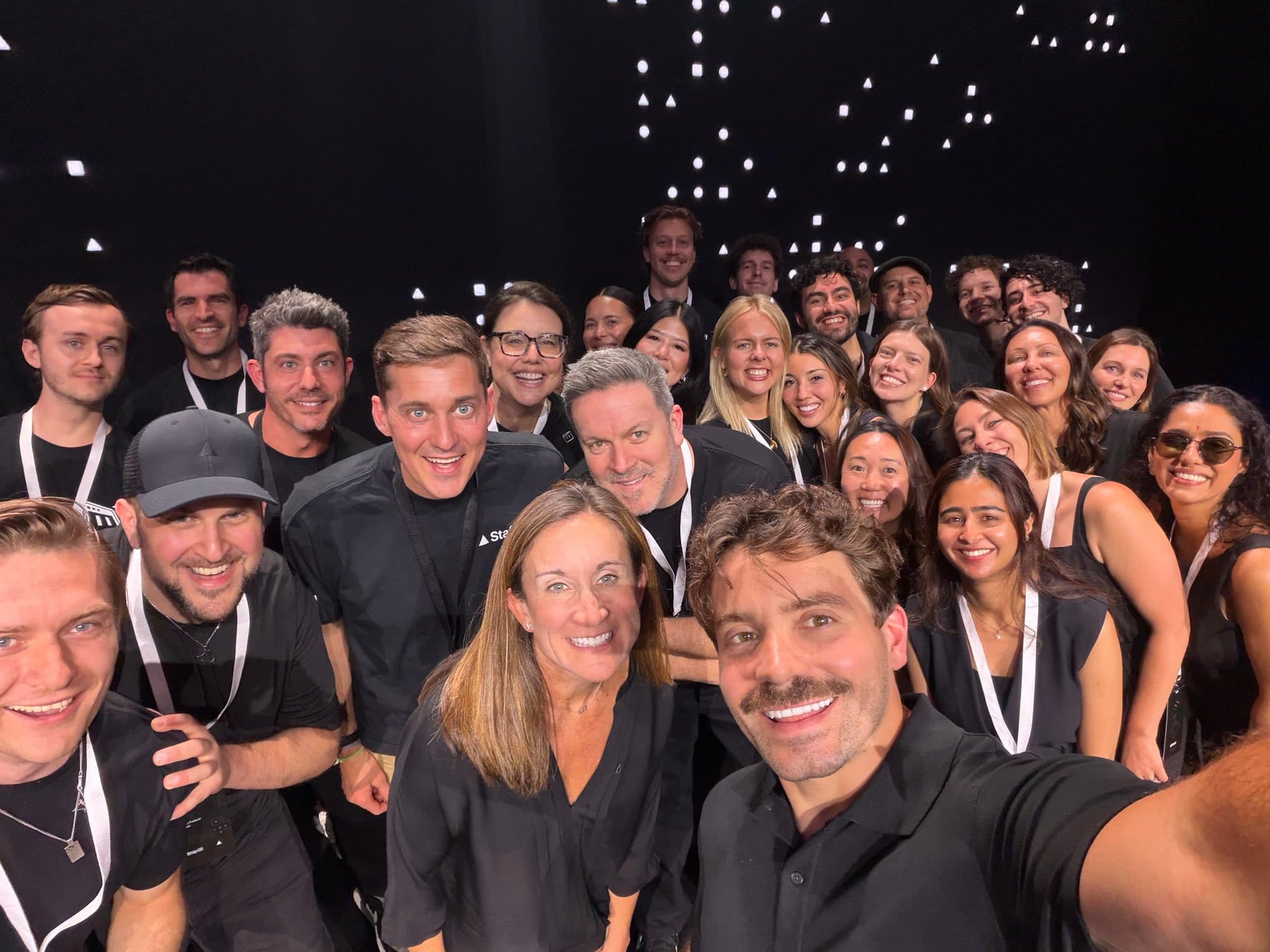
October 6th was my one-year anniversary at Vercel. I asked my friend John Wessel to write down the questions he would ask me about the experience, and he did. Here are my answers.
Eric, it’s been a year since you joined Vercel. How has the experience compared with what you expected? What’s surprised you most?
I knew that Vercel had a reputation for moving fast and holding high standards, but after working here, I learned that both things are true in a much greater measure than I expected.
I didn’t expect true startup speed at a company as large as Vercel because it’s so rare. I have startup experience and was a founder, so I jumped right in, but it was still an adjustment because expectations for the quality of work is so high. It would probably be a shock for someone from a larger, slower-moving company.
I was surprised at how small some of the teams are. When I joined I noticed several 2 or 3-person teams generating the output of 5 people (including the team I joined), and that was before Opus 4.5 and multi-agent workflows. There is almost no unnecessary overhead for things like project management because people own their work end-to-end, and that’s one of the reasons the company can move so quickly.
The biggest surprise was how much responsibility the Content Engineering team has. I joined as an individual writer, and it became clear early on that the most important part of the job was ingesting our worldview and the things we care about, then upholding our values and brand in everything we publish. I say no to publishing content often, even when it comes from people higher up in the company. I’ve even pushed back on the way a feature is implemented after reviewing the changelog and testing it, and realizing it was slightly misaligned with the way similar features operated. I think leading product in my previous job was incredibly helpful in developing intuition for what's right and learning how to say no well.
The best surprise was discovering how few meetings I had to join. I rarely feel like I have to fight my calendar to find focus time, which is critical for writing.
If you could go back to your first day, what’s one thing you’d do differently?
I wish I had spent more time getting to know people around the company, especially in different departments.
Vercel can be an intense place to work and the content team has a perpetually gigantic backlog. I work remotely, and it can feel more efficient to go heads down and attack the backlog, but relationships pay the real dividends in the long run, and there are some really wonderful, fascinating people here who I wish I had met earlier. For example, the other day I found out someone I've worked with on several projects was a physicist at NASA, and I want to learn more about who they are.
What’s one thing you look back on and think, “I’m really glad I did that”?
Every Friday we have Demo Days, and anyone in the company can demo anything they’ve built. Hundreds of people join the call.
My first week, I demoed a very basic AI summary feature I built for my personal blog using AI SDK and AI Gateway. There are so many talented people who demo incredible projects, and I’m not an engineer by trade, so it was intimidating.
I’ll never forget the CTO’s comment in Zoom:
First week ship. Meets expectations.
Looking back, I’m thankful I faced down my intimidation out of the gate because I started speaking my mind much earlier than I might have otherwise.
Also, I'm going to cheat on this question and add one more thing I'm really glad I did. Content Engineers need to have a really good understanding of the product, but Vercel has a huge surface area, so there is a steep learning curve. I was already a user and customer, so I knew the basics, but I only ran small personal projects and didn't use many advanced features.
I'm a big believer in reading documentation to understand a product, but with a family and a new job, it was taking me too long to make it through the Vercel docs quickly. I really wanted to listen to the docs so I could consume the content on runs, at the gym, or in the car.
So, I pulled the docs repo, used Claude to reformat the content into book format, with chapters, and then used ElevenLabs to turn it into an audio file. I used ffmpeg to format it as a true audiobook, then added it to Apple Books. After that, I think I got through the documentation in less than a week. The most helpful part was Apple Books remembering where I left off and tracking progress automatically, and being able to re-listen to chapters.
What’s something you’re doing now that you never expected would be part of the job?
Earlier this summer I had the chance to work with the executive team on writing their keynote speeches for our flagship conference series.
Years ago I had written a few of my own talks for conferences, but this project was new territory, and involved much higher stakes and exposure.
I truly loved the work. Supporting someone in distilling and translating their ideas makes for very engaging conversation. Also, cadence is critical in a keynote, and writing to achieve it is a really hard, really fun challenge. One of the most unique parts of speech writing is learning to communicate something fully in someone else’s voice, and jokes are the most difficult part of that to get right.
What’s something new you’ve tried this year that you’ve discovered you really love doing?
I’ve loved being an editor, in the formal sense of the word.
I write daily for my job, but leading the content team means I also spend a lot of time on editorial work. Editing is something I’ve done previously, but not as a specific job responsibility, and I really enjoy it.
That’s easy to say because my team is very talented, but in general, I’ve learned that editing is a way to engage with writing and ideas on a deep level, with ownership, but without writing the words yourself. As a writer, engaging from the other side is refreshing and forces you to look at content through a different lens.
Seeing someone’s vision and helping them bring it to life is rewarding, and the favor gets returned because there are some very good editors who review my work as well.
What are you most proud of accomplishing with your team this year?
The engineering and product teams at Vercel are prolific, and they write changelogs for almost every product and feature we release, large or small. It’s not uncommon for us to publish over 100 changelogs in a month, and that number has been trending up.
My team reviews every changelog, and the process is more intensive than you would think:
- Review and edit the copy for style and accuracy
- Test the product or feature itself (whenever possible)
- Write a companion post for X announcing the feature
- Help prepare assets (code snippets, screenshots, open graph images)
We use AI heavily as part of this process, but LLMs still can’t replace human judgment on why a feature is important in a specific moment or in the context of the full platform, or knowing when a changelog feels “high craft” because of the way text, images, and code samples are combined. We also spend a lot of time thinking through how a feature should be distilled and positioned for a post on X.
I like to joke that my team is probably in the 90th percentile for product knowledge across the whole company, but it’s probably true. Multiple times a day we develop an understanding of why a feature is important and how it fits into the surface area of the platform, and we literally use the features to understand the product experience.
So, I’m proud that my team can maintain that level of depth and craft at such a high volume.
As you’ve built the team, what one or two qualities in the people you hired have made the biggest difference?
One thing about working at Vercel is that I’ve felt more leverage than ever before in finding extremely talented people. Hiring is always hard, but it’s a real gift to be at a place that people want to be at, hiring for a unique role.
Once I filter for talent, the two things I look for are first-principles thinking and curiosity.
Imagine a writer who is as excited about digging into an interesting historical event as they would be about understanding the technical details of how Sandbox snapshotting works—and who also have strong, well-thought-out opinions on each.
It’s a delight to work with minds that hungry and principled, because they could really do any kind of work or tackle any subject, and it makes their work product much more powerful and interesting.
What’s the best part of working at Vercel? What is it about the culture that makes it special?
For me, there are two things:
- Flat, high-agency culture
- Celebration of craft
I’ve told many people that working at Vercel feels like working at an early-stage startup. As a former founder, that environment is wonderful for me. There are extremely high expectations, but no micromanagement. You are expected to understand what the right thing to do is, then execute, and you have an immense amount of agency to do that.
On the craft side, there is a culture of appreciating and achieving high quality in the work. For how fast the company moves, I was initially surprised at how often we delay publishing something because it doesn’t meet our standard, and it’s very motivating to work with other people who share my love of the endless pursuit of perfection. Working here has taught me how to do very high-quality work very quickly.
As Vercel grows, what’s the biggest bottleneck for your team? How are you working through it?
The hardest work my team does is figuring out how to increase content throughput with AI.
Individually we’ve found a lot of productivity leverage with our various workflows and skills, but the reality is that using LLMs and agents to generate content at a very high level of quality, for human consumption, is extremely hard.
Because of the way AI has impacted software engineering, it can be easy to think about turning content production into a factory, but content is different than code. Code is a means to a product end, but content is the product itself. Code can be tested, but great content often breaks rules, introduces surprises, and achieves subtle variety.
Agents are getting better and better at reviewing code, but our standards require us to have a human review and edit anything written for a human, and that is hard to scale.
My team is made up of very good writers, and it’s funny how often we joke about how bad AI is at writing certain things.
You probably won’t be surprised that we are solving for these challenges by returning to first principles. Content falls on a spectrum of objectivity: documentation is objective fact, but thought leadership articulates subjective ideas.
AI is very well suited to automating significant parts of the objective side of the spectrum, so we are putting most of our effort there first. As we move towards the subjective side, we are asking hard questions, like whether generating “final” prose is even the right goal, and what that means for the role both agents and humans play.
Answering those questions becomes very difficult when you think about productizing AI workflows for non-writers, so we also think a good bit about what AI should and shouldn’t do for those people, and how to teach them to write without them knowing it’s happening.
I’ve never been more convinced that the people who get the most out of AI for writing are very good at writing without it, and do that often, so it’s not just about how capable the models are or how you run agents in loops.
The audience also matters. Our documentation is mostly consumed by AI agents, which is fascinating, and changes the way we think about that content and how it’s created. Because we care so much about craft, when it comes to the subjective side of things, we view AI more as support infrastructure to help human writers move faster, as opposed to a system that can produce an outcome autonomously.
Looking ahead 12 to 18 months, what’s a big, audacious goal you’d love for you or your team to achieve?
I would love for my team at Vercel to set the standard for how to write with AI, both in the philosophical approach and the tools. That’s for tech companies, certainly, but also more broadly because I think the principles apply to all kinds of writing.
Would that goal have seemed out of reach when you first started?
I think so, for two reasons. I hadn’t been a professional writer before, and even one year ago the tooling and models were way behind where they are today.
When I first joined Vercel, I just wanted to figure out how to use AI for myself to do my new job.
What’s one thing you do every week, or every day, that you think would have the biggest payoff if you kept doing it for the next 10 years?
Writing without AI.
One of my favorite quotes about writing is:
Mainly writing means a great deal of hard thinking, the popular impression notwithstanding.
—David McCullough
I would love to keep making a living as a writer, but no matter what I do in the future, clear writing will make me better at it.
I also think that as AI becomes more integrated into our lives and work, writing skill will become even more valuable, both on its own and also because being a good writer makes you far better at using AI than the average person.
Do you have a favorite story from your first year?
There are many, so it’s hard to choose. The first story that comes to mind is about my boss helping me break through writer's block.
I was in the throes of keynote writing, trying to make the ideas in a critical section of the speech flow, and every path I followed was a dead end. I could not figure out how to make it work.
My boss sent me a video about rap lyrics. It was a short documentary analyzing the methodologies used by various rappers over the years to string lyrics, concepts, and stories together across bars. It helped me break through on the speech almost immediately, because it visualized the way that intentionally breaking rules doesn’t just add variety; if done well, it can create a new form of the work altogether.